Before the RFP Goes Out, AI Is Already Building the Shortlist
Owners, agencies, and developers now ask ChatGPT, Perplexity, and Gemini who's qualified before a Statement of Qualifications ever crosses a desk.
Lose a pursuit on paper and at least you get a debrief. Lose this one and you never even find out your firm was in the room.

Our team's expertise, not just our opinion
Our VP of Product Development has been featured by the Southern Economic Development Council for his work on how AI is changing the way organizations get discovered and evaluated. The same principles apply directly to how AI platforms evaluate and shortlist AEC firms. Read the feature →
What happens if your firm goes invisible
There's no debrief for this. No note that says "you weren't shortlisted." An owner or agency asks an AI platform who's qualified, gets an answer, and moves on to build the RFQ list, and your firm never even knows it was in consideration and got cut.
If nothing changes
Firms with thinner qualifications keep getting named instead of you. Pursuits get shaped before your BD team ever hears about the project. Your past performance, your credentials, your sector depth. None of it gets weighed, because none of it got seen. The loss doesn't announce itself. It just shows up as a shortlist you were never on.
If you close the gap
Your firm becomes the name AI gives when someone asks who's qualified for the work. You get considered earlier, on more pursuits, without spending BD hours chasing lists you were never going to make. And the silence stops working against you.
Direct Answer
Answer Engine Optimization is how a firm gets named, not just found, when someone asks an AI platform a qualifications question. For AEC firms, that means showing up when someone asks "who's a strong civil engineering firm for federal stormwater work" or "which architecture firm has courthouse design experience in the Southeast". The kind of question that used to start with a phone call to a colleague now starts with a prompt.
This isn't SEO. It's the next layer.
For years, AEC business development has run on relationships, past performance, and a strong SF330, supported by a website built to rank in search results. That work still matters. But a growing share of the earliest research now skips search entirely. According to Forrester's 2026 Buyers' Journey Survey of nearly 18,000 global business buyers, 94% of B2B buyers used AI during their most recent purchase process, and 55% used it specifically to compare vendors before ever making contact.
When someone asks an AI platform a qualifications question, the platform doesn't hand back a list of firm websites. It hands back one synthesized answer, built from whatever sources it trusts most. Ranking well in Google no longer guarantees you're part of that answer.
Answer Engine Optimization (AEO) organizes your firm's credentials and sector expertise so AI systems can find, understand, and accurately cite them. SEO gets you found in a list. AEO gets you named in the answer. The difference between being one of twenty search results and being the firm an AI platform actually recommends.
The shortlist moved
For seventy years, AEC selection has run on relationships, past performance, and reputation earned project by project. That hasn't disappeared. But the first step in building a candidate list has quietly shifted, from a project manager's Rolodex to a prompt window.
The firms that show up in that first AI-generated answer get considered. The firms that don't, don't. Qualifications don't matter if you're invisible at the moment the list gets built.
Four ways AEC firms lose in AI answers
Four different symptoms. One root cause: your firm going unseen, with nobody raising a hand to tell you it happened.
Absent from the "best of" lists AI engines actually cite
Industry roundups, directory sites, and trade-pub rankings feed AI answers directly. If your firm isn't named on the pages AI pulls from, it's not in the answer.
Sector expertise buried, not surfaced
A firm with real federal, water, or justice-sector depth reads the same as a generalist if that expertise isn't structured anywhere AI can find and cite it.
Personal credentials of principals go unclaimed
Licenses, ENR recognition, and project awards are real authority signals that sit in a bio page instead of getting cited the way AI engines reward.
Fragmented digital footprint
Your firm site, project case studies, press, LinkedIn, and awards are scattered across properties with no single hub an AI engine can point to as the authoritative answer.
A simple three-step plan
Step 1
Scan
We test what AI platforms actually say about your firm right now, across the sector and geography questions that matter to your pursuits.
Step 2
Benchmark
You see exactly where you stand against named competitors, with the verbatim AI answers as evidence.
Step 3
Build
We build the plan that closes the gap in your sector positioning, your principals' credentials, or your fragmented footprint.
This is the same plan, from research to result. No guesswork in between.
Your competitors can't buy the same advantage
We work with one firm per sector and region, not one firm per client roster. Once we're engaged with a firm competing in, say, Southeast federal water infrastructure, we don't take on a second firm bidding the same pursuits. That's an operating limit, not a sales line: if we helped every firm chasing the same program get cited, none of them would actually gain ground.
For a firm operating across multiple sectors and regions, that means the advantage compounds. Each protected combination is one more lane where your competitors simply can't access what you have.
Almost no AEC firm has claimed this yet. Right now, most sector-region combinations are open. That won't stay true.
Why this is harder for AEC
- Selection is qualifications-based, not price-based. So the "proof" has to be real, structured, and specific, not generic marketing copy.
- Sectors matter more than the firm as a whole. Being known for water resilience and being known for justice-facility design are two different visibility problems, not one.
- The buyer isn't always the end owner. Public agencies, developers, and owner's reps all research differently, and AI-mediated research doesn't distinguish between them the way a targeted proposal does.
Your marketing team isn't wrong. They're just not built for this yet.
Your in-house team or agency is good at what they were hired to do: brand, website, proposals, maybe SEO and social. That work still matters, and none of it goes away.
AEO is a different discipline. It's not content or design; it's testing what AI platforms actually say when someone asks a qualifications question, then closing the specific gaps that testing reveals. It requires ongoing measurement across ChatGPT, Claude, Perplexity, and Gemini, and an understanding of how each one weighs and cites sources. That's not a skill set most marketing teams or agencies have built yet. Few had SEO figured out in its first two years either.
We're not asking you to replace anyone. We hand your team the evidence and the plan; they can help execute it, we can, or some mix of both. Either way, someone needs to be doing the testing and translation first, and right now, almost nobody in AEC is.
The answer AI is already giving about you
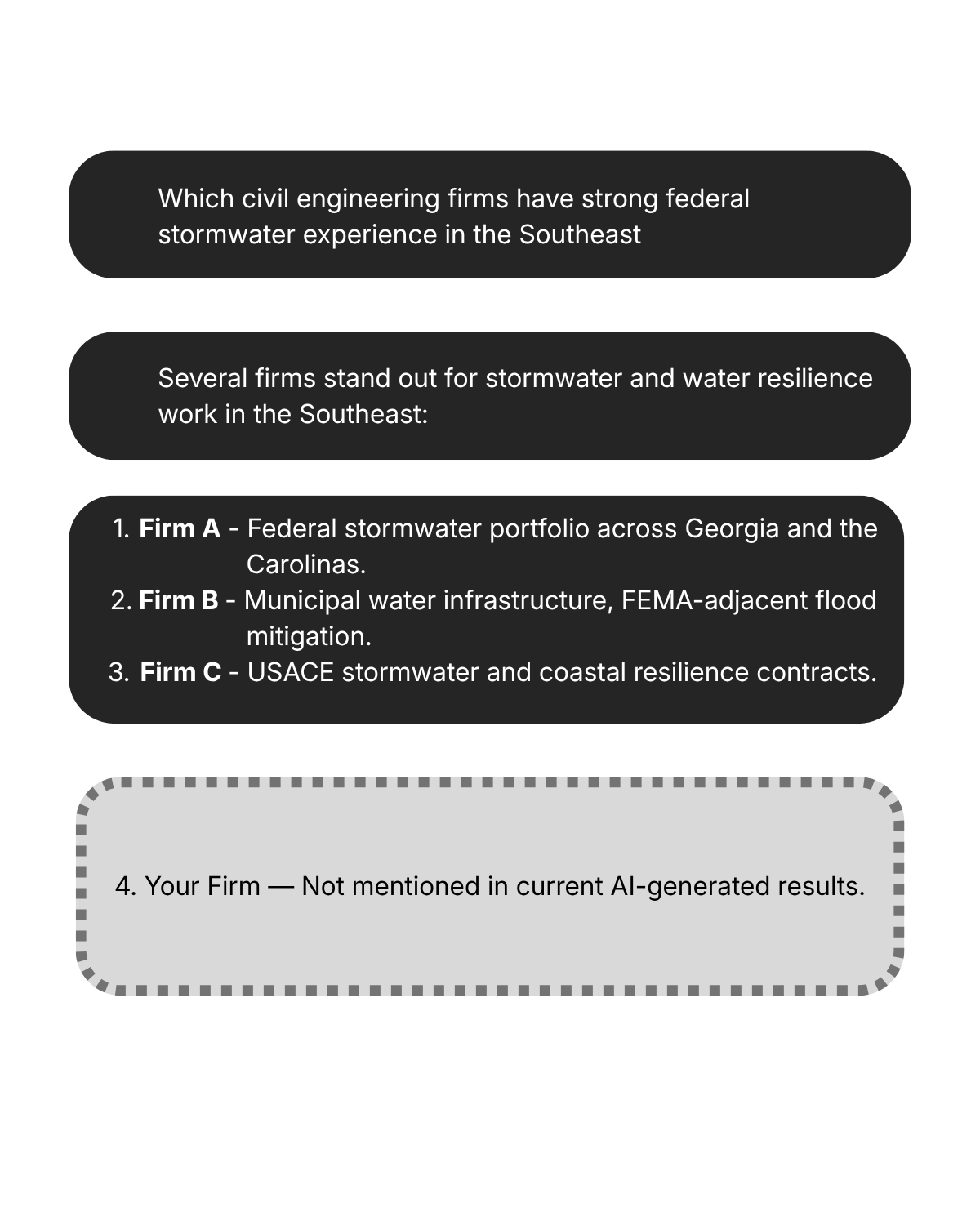
- Whether your firm appears when AI platforms are asked about your core sectors and geographies
- Which competitors get named instead, and why, structurally
- Whether your principals' individual credentials and sector expertise are surfacing at all
- Where the "best of" pages that feed AI answers currently stand, and whether you're on them
- What's fragmented across your firm's digital footprint that's keeping AI from citing you as one clear answer
You get the actual AI answers, verbatim. Not a score.
The DRIFT Framework, applied
Every AEC firm we scan has expertise an AI engine should be citing and isn't. Our proprietary DRIFT Framework, built specifically for qualifications-driven categories, finds exactly where that gap is, in your sector positioning, your principals' credentials, or your firm's fragmented footprint, and builds the plan to close it. It's not a generic SEO checklist adapted for AI; it's a methodology developed for exactly this problem.

Built for firms that compete on qualifications
If your firm's pipeline runs through SF330s, RFQs, and shortlists rather than price quotes, this is written for you.
- Civil engineering firms pursuing infrastructure, water resilience, and stormwater programs
- Structural and MEP engineers competing for institutional and healthcare facility work
- Architecture firms building public-sector, education, and justice-facility portfolios
- Environmental and geotechnical firms supporting federal and water-resource work
- Land surveying and planning firms rounding out full-service AEC pursuits
Different disciplines, same problem: qualified firms losing shortlist visibility to firms that simply said more, in a form AI could find.
Frequently Asked Questions
8 questions
Your Qualifications Are Real. Is AI Citing Them?
Get a benchmark of where your firm stands against the pages AI engines actually pull from, before your next pursuit.
No obligation. We'll follow up with clear next steps.